From Kericini we took a car with a Dutch couple back to Padang. A few days earlier I had been quite convinced that I was going to overland it to Java. The journey from Lake Toba had changed my mind instantly. On arrival I wondered around travel agents and airplane shops hoping to secure a ticket for the following day. At first it wasn’t successful, the prices were high and availability low. To my rescue however came a travel agent that might as well have been shut with how it carried itself but somehow it found my a great price on the correct day of departure.
With tickets in hand we wondered over to Padang beach which doesn’t exist outside of a few rocks being bashed by waves full of rubbish. The market closer to it was a little more interesting with horse drawn carriages and frantic atmosphere.
The next day I flew to Jakarta as Paul returned to England. It was the first domestic flight I have ever taken and was incredibly smooth. On arrival in Jakarta I got a bus straight from the airport to the town of Bogor an hour and a half away. Jakarta is the definition of urban sprawl. I had absolutely no intention of spending any time there at all.
Not that that much more can be said for Bogor. It has almost been engulfed by Jakarta and its traffic seems to standstill most of the time. That said there is a reason for coming, a reason that I imagine made my parents wonder what has happened to their son over the past year. At the center of Bogor with chockablock roads surrounding it lays one of the most impressive botanical gardens in the world. With the help of Kew it covers a substantial amount of ground and is very impressive. When George Bush visited in 2006 the only site he saw in Indonesia were these gardens.
I have little interest in plants beyond thinking they look nice, or oh that’s pretty tall, so apart from seeing the world’s tallest plant, my time in the gardens consisted of a pleasant stroll for a number of hours. It was made all that more enjoyable by going on a Sunday. The lonely planet warned against it because of the huge numbers of locals who flock then, but frankly it made it that much more fun. There were family gatherings everywhere, playing sports and having competitions such as the egg and spoon race. It was a joy seeing so many people making the most of the gardens.
I left Bogor that evening. I hoped to go all the way to Yogyokarta, but as is typical with local bus services nothing ever works out the way you understand it should.

Saturday, 13 August 2011

Wednesday, 3 August 2011
Gurung Kerinci
The Kilimanjaro of the tea estates? Gurung Kerinci is Indonesia’s highest non-Papuan peak. It’s also one of the most active volcanoes in Sumatra having last erupted in 2009. Kesik Tua, a small village in amongst the hills and tea plantations was our base. Looking out from our homestay I was struck by how imposing the volcano looked. It sticks out like a sore thumb shooting up towards the sky amongst fields of tea plantations and cabbage plants. Frequently hidden by cloud, when it was revealed in its full glory it was hard not to be humbled by just how isolated it actually is.
There wasn’t a lot to do on the first day other than rest after the thirty six hour bus journey. We did break at one point from the books to indulge in a first taste of a Durian fruit. Frequently controversial because of its smell, I thought its taste was utterly addictive. It was like eating fruit custard out of a fruit!
It was a first in terms of organising a hike. From waking up in the morning the owner asked why we were in Kesik Tua. There are three possible answers to this. Bird watching, flower hunting or hiking, there are no hang abouts here. It is a place not frequently visited and has no hotels, only a couple of homestays. We were of course after the latter of the options and pointed out of the window to Gurung Kericini. The next day we had sleeping bags, roll mats, torches to add to our already considerable warm weather gear and a personal guide waiting at eight in the morning. Neither of us have ever organised our own personal hike before.
Our guide was Duri, one of the sons of the owner. Another son drove us in his jeep through the tea estates and to the park entrance. I say park entrance although I mean where the road became impassable. A small hut may once have been home to a park ranger but few people pass through here. The hike up to base camp two where we would stay the night was initially a gentle stroll uphill through the forest. Clambering over fallen trees and avoiding encroaching plants it was all very pleasant as birds sang as we passed by and gibbons played up in the trees. A few shelters down the path began to get more technical. The flow of water down the volcano over the years has produced deep channels. Increasingly it was a case of scrambling and swinging from tree to tree to tree.
One of the joys of Kericini is that it does not mess around. It’s all up. As the hours slipped by so did the scenery. From thick jungle to ferns and shrubberies the trees began to disappear the higher we got. After around six hours we got to where we would be staying the night. The tent went up as the rain came down, good timing was an understatement. At around 3,200 meters it was cold. The down jacket was once again out, proving it’s worth every few months. With no watches the rest of the day and night was sat around chatting unsure what the time was. It eventually got dark and the three of us crammed into one tiny tent!
At some unearthly hour, Duri brought us coffee and roti. It was cold, very cold. Torches on we headed up towards the summit. The climb was brilliant fun, plotting our route up a path in absolute tatters, in pitch darkness. Dangerous but highly entertaining, the greenery finally gave way and as the sun came up, the rock and scree infested volcanic peak came into view. It was a torturously slow ascent; many steps were taken only to find ourselves back to square one.
Beautiful views of the landscape a million miles away from the world we were now inhabiting peaked in and out of the clouds. It was an ugly last hour, it was everything that you would want from a volcano. Bleak, bare and violent. At 3,800 meters the air was noticeably thin. At the top it was made that much worse curtsey of the plumes of sulphur that pumped out of the crater. As we sat, with our coats over our mouths, coughing at times uncontrollably we began to estimate how many years we were losing of our lives inhaling the smoke.
We didn’t stay up top too long, the smell and smoke made it almost unbearable, but it felt brilliant to have conquered such an imposing structure. The descent of some two thousand meters was full of all the fun of the ascent. It was a challenge and at times made me think that I was the luckiest man alive having access to such a fantastic theme park. The sight of several varieties of carnivorous plants only capped it off further. Eventually we made it to the bottom, cloaked in mud.
Gurung Kericini in terms of its contrasts and its challenges made for an unforgettable walking experience. Off the beaten track and surrounded by so much natural beauty its one of those places that will live long in the memory.
There wasn’t a lot to do on the first day other than rest after the thirty six hour bus journey. We did break at one point from the books to indulge in a first taste of a Durian fruit. Frequently controversial because of its smell, I thought its taste was utterly addictive. It was like eating fruit custard out of a fruit!
It was a first in terms of organising a hike. From waking up in the morning the owner asked why we were in Kesik Tua. There are three possible answers to this. Bird watching, flower hunting or hiking, there are no hang abouts here. It is a place not frequently visited and has no hotels, only a couple of homestays. We were of course after the latter of the options and pointed out of the window to Gurung Kericini. The next day we had sleeping bags, roll mats, torches to add to our already considerable warm weather gear and a personal guide waiting at eight in the morning. Neither of us have ever organised our own personal hike before.
Our guide was Duri, one of the sons of the owner. Another son drove us in his jeep through the tea estates and to the park entrance. I say park entrance although I mean where the road became impassable. A small hut may once have been home to a park ranger but few people pass through here. The hike up to base camp two where we would stay the night was initially a gentle stroll uphill through the forest. Clambering over fallen trees and avoiding encroaching plants it was all very pleasant as birds sang as we passed by and gibbons played up in the trees. A few shelters down the path began to get more technical. The flow of water down the volcano over the years has produced deep channels. Increasingly it was a case of scrambling and swinging from tree to tree to tree.
One of the joys of Kericini is that it does not mess around. It’s all up. As the hours slipped by so did the scenery. From thick jungle to ferns and shrubberies the trees began to disappear the higher we got. After around six hours we got to where we would be staying the night. The tent went up as the rain came down, good timing was an understatement. At around 3,200 meters it was cold. The down jacket was once again out, proving it’s worth every few months. With no watches the rest of the day and night was sat around chatting unsure what the time was. It eventually got dark and the three of us crammed into one tiny tent!
At some unearthly hour, Duri brought us coffee and roti. It was cold, very cold. Torches on we headed up towards the summit. The climb was brilliant fun, plotting our route up a path in absolute tatters, in pitch darkness. Dangerous but highly entertaining, the greenery finally gave way and as the sun came up, the rock and scree infested volcanic peak came into view. It was a torturously slow ascent; many steps were taken only to find ourselves back to square one.
Beautiful views of the landscape a million miles away from the world we were now inhabiting peaked in and out of the clouds. It was an ugly last hour, it was everything that you would want from a volcano. Bleak, bare and violent. At 3,800 meters the air was noticeably thin. At the top it was made that much worse curtsey of the plumes of sulphur that pumped out of the crater. As we sat, with our coats over our mouths, coughing at times uncontrollably we began to estimate how many years we were losing of our lives inhaling the smoke.
We didn’t stay up top too long, the smell and smoke made it almost unbearable, but it felt brilliant to have conquered such an imposing structure. The descent of some two thousand meters was full of all the fun of the ascent. It was a challenge and at times made me think that I was the luckiest man alive having access to such a fantastic theme park. The sight of several varieties of carnivorous plants only capped it off further. Eventually we made it to the bottom, cloaked in mud.
Gurung Kericini in terms of its contrasts and its challenges made for an unforgettable walking experience. Off the beaten track and surrounded by so much natural beauty its one of those places that will live long in the memory.
Lake Toba to Kericini
The journey down to Lake Toba was similar to Berastagi. Read: triple the number of people to seats and Paul unable to get his legs in between the seats and his head from popping out of the roof. Oh how good it is to be of a smallish height. As we approached the ferry I listened to one of my many podcasts, ‘from our own correspondent’. It brought a smile to my face to hear one of the radio four news reporters doing a piece on why people in Cambodia find foreigners cycling so funny! They were specifically focusing on Kampot province, the area where I did my three days on a one speed bike.
Danau Toba is the largest lake in Southeast Asia covering 1707 square kilometers. It is big. The ferry into the center took close to an hour. Tuk Tuk, attached to a lager island, with over a one hundred kilometer circumference is the tourist heart. In days gone by it was one of the major stops on the traveler’s itinerary, championing a party scene that Hat Rin on Koh Phan gan, Thailand now holds. These days the island verges on a ghost town, with only a sprinkling of foreign tourists.
It’s a real shame that this is the case as the area is absolutely stunning. Renting bicycles and cycling out into the countryside was one of my finest cycling experiences to date.
Mountains to one side, glistening blue waters to the other, locals called out hello at almost every house we passed. We didn’t seem to find any of the noteworthy sights but it didn’t matter, with nearly thirty miles covered, up and down hills, it was a joy to see such a beautiful area of the world.
It would have been nice to have stayed there a couple more days although I’m not entirely sure what else I would have done. Unfortunately Sumatra is not kind in terms of getting from place to place. Our next stop, Kericini lay some five hundred kilometers away.
We started what turned into the most epic journey of my travels at two in the afternoon where we caught a ferry to the mainland. From there we walked to the clearly marked bus station, large and well organized, just with no busses. One travel agent sold us a ticket on the one bus going anywhere that by luck, happened to be our bus. The problem was it was a Sunday; that meant lots of locals on the move. We got given ‘extra’ seats or in other words a plastic seat in the isle. Considering the journey was overnight this was not great news but sometimes needs must. As luck would have it, someone upstairs intervened and two people failed to make the bus on time hence giving us…two seats!
I sat next to an English university student which was nice. She practiced her English and taught me some more Indonesian although I had to give up on how to ask for a room because the vibration on the final word was just impossible for me to say. It surprised her that I had never heard of England’s greatest export, Mr Duncan, and frankly alarmed her when I said we don’t eat rice three times a day.
The rest of the journey was a typical night bus affair, bumpy, sometimes slow, sometimes fast, the barest of sleeping times. Considering we were on the wonderfully named Trans-Sumatran Highway, finding ourselves on mud tracks and roads only just big enough for a car, with two busses attempting to pass each other, the journey was hard going. Unlike most night busses it was not over at first light. No, we didn’t make it to base until two in the afternoon, that’s twenty two hours, with only two fifteen minute breaks and a couple of packets of biscuits.
Actually it wasn’t all that painful, what was, was when we arrived at the bus office in Padang. Now the Lonely Planet has a lovely piece on Padang, with a good map and plenty of information. Except then it contains a box which states that just before going to print there was an earthquake that destroyed much of the city. With no reference points, no one speaking English and worst of all no form of transport, we were stranded in the pouring rain.
Eventually a couple of students passed by. One was Indonesian, the other Malaysian. With their help we navigated a number of oplets before arriving at a different office which could book us on a bus to Kerinici. I can’t explain just how stuck we would have been without them. We went over the road and had a taste of the famous Padang cuisine. The waiter puts around fifteen dishes on your table and you pay for what you eat. I enjoyed the beef rendang, a morning glory dish, omlette, oh and a whole dish of cow intestines. No one else wanted to help me out with that one. At one point an older lady came over and sat a chair away. She starred at us continuously whilst at the same time holding an in-depth conversation with our new found friends. She looked bewildered and confused. Was it the white skin? The language? The handling spicy food? No it was confusion over why we were eating rice with a fork and not a spoon.
After lunch, the first proper meal for twenty four hours we collapsed and waited for the bus. Alex and James disappeared at various times and brought back local snacks for us to try. By far the strangest was chicken feat in a curry sauce.
Approaching zombie status it was time for the mini bus to leave for Kericini. We got in and then the driver did. Finally a chance to sleep. But wait, no! We were in for a treat. Unknown to us the mini bus that we booked happened to have the best speaker system in the whole of Asia! Cue dance and then local music throughout the night at a near deafening sound volume. My tolerance levels were tested to their absolute limits. But the whole grin and bear it approach did just about work as we were dropped off in a tiny village at around three in the morning. It was all very picturesque with the volcano dominating above the tea plantations but my zombie status renders that image nearly defunct. Rather my enduring memory was Paul knocking on a homestay’s door and a wonderful if sleepy man greeting us and ushering us into a room. We hit the hay almost instantly.
Thirty six hours, the next day was a right off.
Danau Toba is the largest lake in Southeast Asia covering 1707 square kilometers. It is big. The ferry into the center took close to an hour. Tuk Tuk, attached to a lager island, with over a one hundred kilometer circumference is the tourist heart. In days gone by it was one of the major stops on the traveler’s itinerary, championing a party scene that Hat Rin on Koh Phan gan, Thailand now holds. These days the island verges on a ghost town, with only a sprinkling of foreign tourists.
It’s a real shame that this is the case as the area is absolutely stunning. Renting bicycles and cycling out into the countryside was one of my finest cycling experiences to date.
Mountains to one side, glistening blue waters to the other, locals called out hello at almost every house we passed. We didn’t seem to find any of the noteworthy sights but it didn’t matter, with nearly thirty miles covered, up and down hills, it was a joy to see such a beautiful area of the world.
It would have been nice to have stayed there a couple more days although I’m not entirely sure what else I would have done. Unfortunately Sumatra is not kind in terms of getting from place to place. Our next stop, Kericini lay some five hundred kilometers away.
We started what turned into the most epic journey of my travels at two in the afternoon where we caught a ferry to the mainland. From there we walked to the clearly marked bus station, large and well organized, just with no busses. One travel agent sold us a ticket on the one bus going anywhere that by luck, happened to be our bus. The problem was it was a Sunday; that meant lots of locals on the move. We got given ‘extra’ seats or in other words a plastic seat in the isle. Considering the journey was overnight this was not great news but sometimes needs must. As luck would have it, someone upstairs intervened and two people failed to make the bus on time hence giving us…two seats!
I sat next to an English university student which was nice. She practiced her English and taught me some more Indonesian although I had to give up on how to ask for a room because the vibration on the final word was just impossible for me to say. It surprised her that I had never heard of England’s greatest export, Mr Duncan, and frankly alarmed her when I said we don’t eat rice three times a day.
The rest of the journey was a typical night bus affair, bumpy, sometimes slow, sometimes fast, the barest of sleeping times. Considering we were on the wonderfully named Trans-Sumatran Highway, finding ourselves on mud tracks and roads only just big enough for a car, with two busses attempting to pass each other, the journey was hard going. Unlike most night busses it was not over at first light. No, we didn’t make it to base until two in the afternoon, that’s twenty two hours, with only two fifteen minute breaks and a couple of packets of biscuits.
Actually it wasn’t all that painful, what was, was when we arrived at the bus office in Padang. Now the Lonely Planet has a lovely piece on Padang, with a good map and plenty of information. Except then it contains a box which states that just before going to print there was an earthquake that destroyed much of the city. With no reference points, no one speaking English and worst of all no form of transport, we were stranded in the pouring rain.
Eventually a couple of students passed by. One was Indonesian, the other Malaysian. With their help we navigated a number of oplets before arriving at a different office which could book us on a bus to Kerinici. I can’t explain just how stuck we would have been without them. We went over the road and had a taste of the famous Padang cuisine. The waiter puts around fifteen dishes on your table and you pay for what you eat. I enjoyed the beef rendang, a morning glory dish, omlette, oh and a whole dish of cow intestines. No one else wanted to help me out with that one. At one point an older lady came over and sat a chair away. She starred at us continuously whilst at the same time holding an in-depth conversation with our new found friends. She looked bewildered and confused. Was it the white skin? The language? The handling spicy food? No it was confusion over why we were eating rice with a fork and not a spoon.
After lunch, the first proper meal for twenty four hours we collapsed and waited for the bus. Alex and James disappeared at various times and brought back local snacks for us to try. By far the strangest was chicken feat in a curry sauce.
Approaching zombie status it was time for the mini bus to leave for Kericini. We got in and then the driver did. Finally a chance to sleep. But wait, no! We were in for a treat. Unknown to us the mini bus that we booked happened to have the best speaker system in the whole of Asia! Cue dance and then local music throughout the night at a near deafening sound volume. My tolerance levels were tested to their absolute limits. But the whole grin and bear it approach did just about work as we were dropped off in a tiny village at around three in the morning. It was all very picturesque with the volcano dominating above the tea plantations but my zombie status renders that image nearly defunct. Rather my enduring memory was Paul knocking on a homestay’s door and a wonderful if sleepy man greeting us and ushering us into a room. We hit the hay almost instantly.
Thirty six hours, the next day was a right off.
Friday, 22 July 2011
Brestagi
It was one of those Indonesian mini buss hopping adventures to get to Brestagi. Constantly crammed and made for smaller people than me (how Paul coped I will never know) they were a constant fascination as well as moving torture mobiles.
Brestagi is what I have come to understand as a typical Indonesian town. Ugly, busy and a little bit dirty. We weren’t here to admire the town however; we were here to climb a volcano, Gurung Simayek. The following day we set off with a hand drawn map and a lunch box and began to walk towards the entrance to the park. We were soon lost. Not to be deterred and a couple of waving hands from locals later we were back on track and began the winding ascent up the paved road. At one point we came across a group of Indonesian students wondering down with a guitar. I asked them to play a song. They ushered us into the road and began strumming along. We talked a little bit and then scarpered as a mini bus swung around the corner. Laughing we parted and continued up the hill.
The road soon disappeared and we got to play a game of can you find the mud path up to the volcano. After a while it turned out we could, latching onto the most indistinguishable path possible. It took us up into the mountains. The beautiful greenery soon gave way and the top of the volcano was in view. It’s hard to remember what hit first, the sight of it, the smell of it or the noise of the sulphur escaping from the vents. The crater itself is dry and now covered in peoples messages made out of stones. Surrounding it however are green glows, with smoke pouring out and loud hissing noises. I put my hand over one, it was boiling hot! I’ve never been on an active volcano before. The experience was quite something.
We spent some time around the area and then began our descent down. It was smooth enough until our ‘not to scale’ map decided to take us on a walk far beyond what would be seen as acceptable considering we’d just climbed a decent amount already. After goodness knows how long (at least an hour I’d suggest) we finally hit a main road. We sat down. A motorbike taxi asked us if we wanted a lift into town. “Us! No, we’re hikers, and pretty good at it, we’ll walk it, it’s not far anyway, just look at the map!” He didn’t attempt to persuade us, which was strange considering after a while we passed a sign saying eight kilometers to Brestagi. Considering by this point we had been walking for six odd hours that’s no mean distance. Determined we polished it off in impressive time. It had been a great day although I was quite happy to be back at the hotel and with no more than ten steps to navigate between the room and the restaurant.
Brestagi is what I have come to understand as a typical Indonesian town. Ugly, busy and a little bit dirty. We weren’t here to admire the town however; we were here to climb a volcano, Gurung Simayek. The following day we set off with a hand drawn map and a lunch box and began to walk towards the entrance to the park. We were soon lost. Not to be deterred and a couple of waving hands from locals later we were back on track and began the winding ascent up the paved road. At one point we came across a group of Indonesian students wondering down with a guitar. I asked them to play a song. They ushered us into the road and began strumming along. We talked a little bit and then scarpered as a mini bus swung around the corner. Laughing we parted and continued up the hill.
The road soon disappeared and we got to play a game of can you find the mud path up to the volcano. After a while it turned out we could, latching onto the most indistinguishable path possible. It took us up into the mountains. The beautiful greenery soon gave way and the top of the volcano was in view. It’s hard to remember what hit first, the sight of it, the smell of it or the noise of the sulphur escaping from the vents. The crater itself is dry and now covered in peoples messages made out of stones. Surrounding it however are green glows, with smoke pouring out and loud hissing noises. I put my hand over one, it was boiling hot! I’ve never been on an active volcano before. The experience was quite something.
We spent some time around the area and then began our descent down. It was smooth enough until our ‘not to scale’ map decided to take us on a walk far beyond what would be seen as acceptable considering we’d just climbed a decent amount already. After goodness knows how long (at least an hour I’d suggest) we finally hit a main road. We sat down. A motorbike taxi asked us if we wanted a lift into town. “Us! No, we’re hikers, and pretty good at it, we’ll walk it, it’s not far anyway, just look at the map!” He didn’t attempt to persuade us, which was strange considering after a while we passed a sign saying eight kilometers to Brestagi. Considering by this point we had been walking for six odd hours that’s no mean distance. Determined we polished it off in impressive time. It had been a great day although I was quite happy to be back at the hotel and with no more than ten steps to navigate between the room and the restaurant.
Thursday, 21 July 2011
Bukit Luwang

Just the twenty two hours to Bukit Luwang via Medan. After various changes of vehicles we arrived, just about in one piece surrounded by the lush jungle of the Gunung Leuser National Park. Bukit Luwang prides itself on being one of the most accessible places in the world to see orangutans. For a number of years now it has been rehabilitating orangutans back into the wild; a project which has been recognized by the WWF as a total success.
Arriving in the early afternoon we made our way up to the feeding platform where twice daily they provide food for the semi wild orangutans, yet to take the full leap to independence. We had met a guide called Eddie on the mini bus in and had agreed to go on a trek with him into the jungle for the following day along with two other people. Somewhere along the line in our conversation with him both Paul and I left with the impression that the feeding started at two in the afternoon despite everything else saying three.
The walk up the hill was pleasant. Huge numbers of locals from Medan tubed down the river and ate food next to it. There was such an un-spoilt atmosphere to the place. Everyone was out to enjoy themselves against a backdrop of spectacular dense jungle. After a short walk we came across a canoe tied to a zip line. The entrance to the park lay across the river. A couple of people hung around but there seemed very little activity, strange considering we were so close to feeding time. We got in the canoe and started to pull ourselves across. A local jumped on and helped with the work. He then paddled back.
We wondered in through the gates and past the park rangers office. Two men lay asleep in hammocks. We didn’t wake them up. We were in a rush to get to the feeding deck in time after all. Another short walk up hill and a couple of turnings later and we arrived at what we assumed was the feeding area except nobody was there. We sat on a log and waited.
After a while I got bored and headed down another path to see what was around the corner. I returned shortly after and Paul pointed up into a tree. There above sat a mother and her baby. It was a special moment seeing these incredible creatures up above us. We watched for a long time before Paul decided he’d go and find out what was happening about the feeding time. He returned to see me in a state of laughter pulling poo out of my hair. After a steady stream of urine minutes earlier that I had successfully dodged, I was caught by surprise by the dropping of excrement from above. It sure did smell.
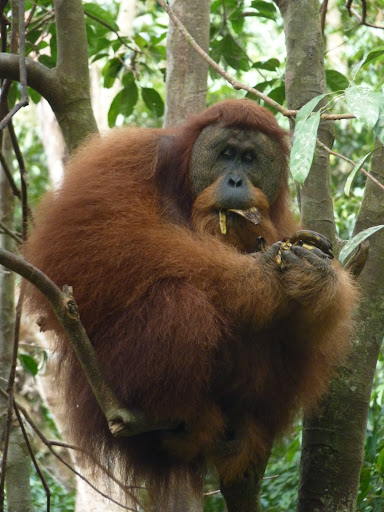
It was then that we turned around and saw a large adult male sat on the feeding platform with a bunch of bananas in his mouth. I didn’t know that orangutans could grow so big, he was massive! The facial expressions he pulled as he watched us, the mother and baby and the bananas he was trying to eat was hilarious. Minutes later a local guy appeared and the male went back into the overgrowth.
Shortly after that the hundreds descended on us. Led by a number of park rangers it was time for the feeding circus. The lead guide walked up to the platform and looked back on the watching crowd. Seconds later he was running back towards us as the male orangutan crept up behind him. It took a long time and a lot of negotiating before he went back up to drop the food!
As this was going on another guide sat down with us and expressed surprise as to how we got there. Telling him we navigated the canoe over the river seemed to confuse him even more. After a short lecture as to how dangerous it was to be alone in the jungle with the orangutans we went back to watching the chaos of dozens of locals in a peaceful jungle. Not that I would ever want to encourage people to flout the parks rules but the feeding time was a nightmare, whilst the hour before, magical. A few bananas later and we left back down towards our hut to prepare for the following day.
We awoke early and wondered over to where we had arranged to meet Eddie and the other two in our group. Unfortunately Sumatran journey time had not been to kind to the other two who had to postpone their trip due to arriving so late in the evening. Instead we were palmed off onto Erwin and Johnny. We joined with a very brave French family, taking their kids out of school for six months and navigating a six year old through the terrain! There was also a couple of Australians which provided plenty of banter on route.
Within the first two hours of trekking into the jungle we had seen eleven orangutans. Of all different sizes and plenty of mothers and babies it was wonderful seeing mans closest relative up close in their natural habitat. Normally animal sightings are fleeting but not these. The orangutans seemed just as interested in us as we were in them.
Not long after that we came across ‘white gloved’ gibbons high up in a tree. Huge ants ran across the floor (and sometimes in Erwin’s mouth) the jungle was full of life. It was all going perfectly to plan until Erwin stopped us in our tracks. He uttered one word, “Mina”. Almost as soon as you step foot in Bukit Luwang you hear about her. Responsible for sixty five attacks on tourists and guides she truly is the queen of the jungle. As our guides rushed ahead to divert her we eventually had to change our route and crossed the small river at a different point. Soon after we settled down for a snack and began to come to terms with how lucky we had been with the animal sightings so far.
“Quick, Mina, go!” the guides suddenly shouted and everyone grabbed for their bags. In the distance branches moved. An orangutan and its baby were swinging in from the distance. It was a majestic sight to see how quickly they can move when they want to. As it landed in front of us you could feel the relief as Erwin identified it not as Mina. Everyone could relax. Except some relaxed too much, choosing to ignore the whole, keep your distance, they are wild animals. I stood a distance away, hesitant to get as close as some of the children were. Next thing I knew, I had a orangutan running at me. I grabbed my bag and moved out of the way as it charged on through and into the bushes. There wasn’t a lot of time to think before we were moving again as the real Mina had found us and we needed to get going. A short flash of orange was all I saw before being motioned up the hill and away.
The rest of the day was uneventful, but thoroughly enjoyable, if a little tiring in the heat. We admired centuries old trees and enjoyed such ‘delicious’ snacks as jungle ice cream. In the late afternoon we arrived at camp. Sitting alongside the river, it was a simple set up with a mat to sleep on and some tarpaulin over the top to keep the rain off. Our guides started to cook up tea and we all went for a swim in the river, battling against the strong currents that attempted to pull us back down stream. After another superb meal we played various games with matchsticks into the night. Erwin and Johnny win the prize for the most amusing and entertaining guides I have had. They have provided plenty of games to take back into schools when I return.
We awoke to monkeys looking down upon us and enjoyed another morning swim. A little later we went up and visited a couple of waterfalls, set back within the jungle. Then it was time to return back to base. A large monitor lizard made its home in our camp whilst we attempted to get our belongings in order. Eventually it moved on and the guides began to strap together four rubber tubes to form a raft. Armed with two wooden poles we rafted the rapids back to town. It was a great way to end a very special and memorable trip.
Docking on shore we made our way up to the so called bat cave. It was amusing trying to find it, passing the swallow cave, the new cave etc. Success followed slowly and we went in with one fading head torch. The cave itself was fairly uninspiring but for the gaps where sunlight filled the cavern and everything became very green. That was all rather Indiana Jones.
After another well deserved sleep we left the following day for Berastagi. Bukit Luwang was one of those places that will stay with me for a very long time. So far Sumatra is outdoing herself.
Wednesday, 20 July 2011
Pulau Weh
We caught a taxi out to the ferry and one hour later we were on the small island of Pulau Weh. I say small, it was still another hour to get to the beach of Iboih, but in comparison to Sumatra it’s a mere pin prick.
Iboih is a small collection of huts strung out mostly along the hillside. It didn’t take us long to have our sea side real estate secured. Sure a Jenga tower looked far more stable than the rickety mess that we agreed to rent but it came with two hammocks, a large balcony and only five steps to walk down until your feet touched the ocean. Two more and we were underwater dodging schools of fish ranging from the miniscule to the frighteningly large. Lion fish, sea snakes, trigger fish, the cast of Finding Nemo and thousands more that I could never hope to identify.
Most of the time on the island was spent in-between a hammock and the ocean. We broke the trend on one afternoon and hired a canoe. The owner looked excited when we pointed at the sign and he pointed at the canoe. A traditional thin boat made out of wood and outriggers made out of piping with a finishing coat of Rastafarian colours. It was entertaining if the distance covered was minimal. Paul got the short end of the stick by getting into the boat at the back and hence forth became the paddler. I perched at the front attempting to keep the balance of the boat.
Initially we directed the boat around the small island that hovered just off Pulau Weh. We soon discovered the open water that was revealed was no place for a traditional canoe. Steering went out of the window as the sea got choppy and the currents cut in. Before we knew it we were back near our accommodation. Instead we rowed over to the small island and pulled the boat as far onto the beach as we could. Just in case we tied it to a rock and wedged it in between another one. Who says Bear Grills is not one of England’s finest educators?
On the far side of the island was a coral garden. After a couple of photos with visiting local tourists we were allowed into the water and swam between them floating aimlessly with the waves in their life jackets. The coral wasn’t in its best shape but some parts were living. There was a typical abundance of fish and a sea snake which was all rather exciting. Getting back in contained the typical problem of not standing on the coral as the tide had an altogether different idea.
Upon getting back to the beach we were relieved to find the boat as we had left it, on the beach, not in the ocean. Unfortunately however it seemed to have lost all buoyancy. The first attempt to launch it was hastily called off as it began to sink. After an investigation and minor fixes we took to the ocean and paddled as fast as possible to get it back to the restaurant without it sinking. It was touch and go, a lot of bailing out took place!
We left Pulau Weh the following day. If there is one problem with the island it is that it is in the middle of nowhere. Neither of us dared to think just how long it would take to reach Bukit Luwang.
Iboih is a small collection of huts strung out mostly along the hillside. It didn’t take us long to have our sea side real estate secured. Sure a Jenga tower looked far more stable than the rickety mess that we agreed to rent but it came with two hammocks, a large balcony and only five steps to walk down until your feet touched the ocean. Two more and we were underwater dodging schools of fish ranging from the miniscule to the frighteningly large. Lion fish, sea snakes, trigger fish, the cast of Finding Nemo and thousands more that I could never hope to identify.
Most of the time on the island was spent in-between a hammock and the ocean. We broke the trend on one afternoon and hired a canoe. The owner looked excited when we pointed at the sign and he pointed at the canoe. A traditional thin boat made out of wood and outriggers made out of piping with a finishing coat of Rastafarian colours. It was entertaining if the distance covered was minimal. Paul got the short end of the stick by getting into the boat at the back and hence forth became the paddler. I perched at the front attempting to keep the balance of the boat.
Initially we directed the boat around the small island that hovered just off Pulau Weh. We soon discovered the open water that was revealed was no place for a traditional canoe. Steering went out of the window as the sea got choppy and the currents cut in. Before we knew it we were back near our accommodation. Instead we rowed over to the small island and pulled the boat as far onto the beach as we could. Just in case we tied it to a rock and wedged it in between another one. Who says Bear Grills is not one of England’s finest educators?
On the far side of the island was a coral garden. After a couple of photos with visiting local tourists we were allowed into the water and swam between them floating aimlessly with the waves in their life jackets. The coral wasn’t in its best shape but some parts were living. There was a typical abundance of fish and a sea snake which was all rather exciting. Getting back in contained the typical problem of not standing on the coral as the tide had an altogether different idea.
Upon getting back to the beach we were relieved to find the boat as we had left it, on the beach, not in the ocean. Unfortunately however it seemed to have lost all buoyancy. The first attempt to launch it was hastily called off as it began to sink. After an investigation and minor fixes we took to the ocean and paddled as fast as possible to get it back to the restaurant without it sinking. It was touch and go, a lot of bailing out took place!
We left Pulau Weh the following day. If there is one problem with the island it is that it is in the middle of nowhere. Neither of us dared to think just how long it would take to reach Bukit Luwang.
Thursday, 7 July 2011
Banda Aceh - Indonesia
The moment I saw that we could fly into Banda Aceh, Indonesia, I jumped at the opportunity. Firstly its close proximity to Pulau Weh appealed but in many ways it was its fascinating if traumatic recent history that made me change the flight plans instantly.
For much of the 1990’s it had been under martial law and after failed peace talks in 2003 it had witnessed the largest military operation by the Indonesian army since 1975. A tiny tourist quota existed, but largely it remained a place outside of the radar of the west. It all changed in 2004 and the Boxing Day tsunami killing around 200,000 people. Sixty per cent of the city was destroyed. Banda Aceh had no choice but to seek the support of the outside world. More recently amongst the huge rebuilding success it has courted controversy by implementing Sharia Law in 2009. It is not uncommon for stonings to occur and alcohol is banned amongst many other things. A couple of days before we arrived I read in a Malaysian newspaper how a Muslim extremist training camp in the province had been infiltrated and its leaders arrested. It promised to be like a place that I had never visited before.
On getting off the plane, amongst the paddy fields and mountain range in the background I was struck by the queue that soon developed around immigration. It was huge, nearly stretching back to the plane. Above the desk read ‘Indonesian passport holders.’ To the right sat a desk, with two officials and no one in sight, ‘foreign passport holders’ this one read. Despite first and only in queue it still took a lengthy time to get through with the officials seemingly perplexed by the two month visa I held. Eventually I was allowed in and Paul soon after thanks to a relatively smooth visa on arrival process.

We made our way to our hotel which had had a makeover in recent years converting itself into a residential block awash with Indonesian families and us. The first thing that strikes you about Banda Aceh is the incredible rebuilding work that has taken place in the last six years. If you were just passing through you would be none the wiser as to the tragedy that struck. There are though a few signs still left. One was a 2km walk from our hotel. A large fishing boat sits precariously on top of a house, a long way from the ocean. It’s become one of the enduring images of the tsunami and helped to put into context what happened on that day.
Very recently Banda Aceh has completed its tsunami museum. One of the finest museums I have been to, it’s very avant garde. Upon entering you pass through a darkened room, along a narrow path, with two waterfalls spraying water over you from a great height. Wet, you enter into a room of mirrors with computer screens showing images taken during the tsunami. Harrowing, they told their own story. The rest of the museum was dedicated towards videos, many more pictures and selected information. It really was a very good museum made that much more sobering by the realization that most of the people we were sharing it with had lived through it.
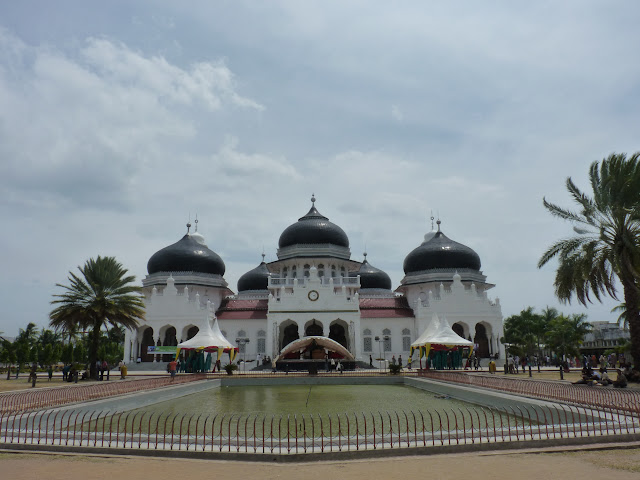
Indonesian is the most populated Muslim country in the world. Aceh in many respects Indonesia's most devout. To gain a greater understanding we visited the Masjid Raya Baiturrahman. The mosque is spectacular, so dominant in the city it is a wonderful example of architecture. We didn’t get to see much of the inside other than peering in through the odd door, but it looked every bit as good as the outside. As we walked around we were greeted by families and others asking for us to appear in photos with them. The warmth and friendliness of the place was infectious. After reading the lonely planets ten things not to do in Banda Aceh it was amusing at one point to find myself posing for a photo with a Muslim lady surrounded by a group of watching local men with the mosque as the backdrop. It was the only moment in my time in Banda Aceh when I thought to myself ‘have I just gotten myself in trouble?’I needn’t have worried, they found it hilarious.
If there was to be one negative it would be the general sleep disturbances which I am sure will become the norm in Indonesia. Firstly you’ve got the expected morning prayers from the mosques. It’s actually quite a nice way to wake up and I always enjoyed it in India, just shame it’s not a little later. Then there are the mysterious men and their whistles paid to help cars park and get back out onto the road. It’s a job that I can think of no comparisons. Mind boggling and enough to drive a man insane when trying to drop off to sleep to the sound of the repeated blowings of a whistle.
Banda Aceh is one of those places that the perceived negatives put off many from visiting. For us however it was an absolute pleasure. The sights were interesting and the people just lovely. The city never felt unsafe. A great start to Indonesia.
Subscribe to:
Posts (Atom)