Friday, 29 October 2010

Manali

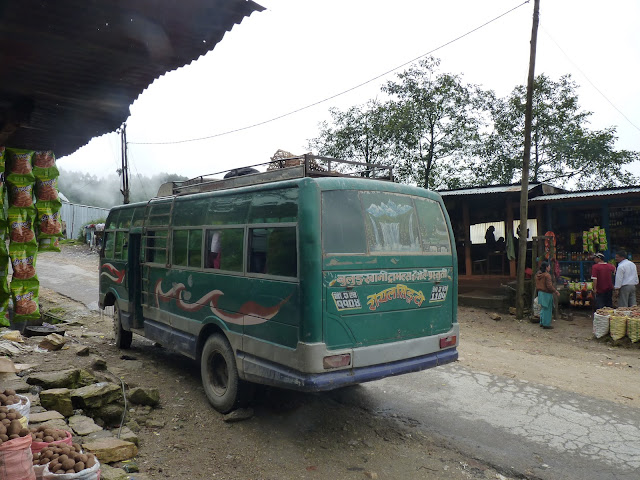
The overnight bus ride to Manali was torture. It's to the continuous puzzlement of every traveler I have talked to on the road why exactly it always seems like the 'right' option. Sure you save a few pennies plus you don't have to pay for accommodation but the pain that is involved barely makes it worth it.

Taking my seat on the 'ordinary' government bus compounded these thoughts. The seats had next to no padding leaving pretty much a metal bar to sit on. Directly in front of the seat was another metal bar to help you hang on when the bus takes the corners at reckless speed. It also provided a target for my head to plummet towards every time that the bus broke sharply. There was no head rest leaving a fragile window as the only place to rest. Behind me sat a Tibetan woman, who under the influence of something, went through a familiar routine. Fall asleep, wake up, open the window into my shoulder and head, fall asleep, get woken up because her head is out of the window, close the window and so on for 10 hours.

After no sleep I joked with the other Western inmate on the bus, who had reached his destination at the time of 2:30am. He turned and said 'this is not good'. One hour later I was uttering the same words. As I stumbled off of the bus, three touts approached. The tone in my voice must have informed them that it was too early in the morning for this and they hobbled back towards the shadows.

As I wondered down the main street in a sleepless daze there was not another person around. There were dogs though. Packs ten strong controlled the streets at this hour. It was not a pleasant place to be as rival packs fought for territory and I happened to find myself in the middle of it.

Fortunately I had been told to stay around 3km outside of Manali at either Vashisht or Old Manali. I liked the sound of the name of the first place and so started the climb out of Manali and away from the essentially wild dogs. As soon as I crossed the bridge and away from the lights, the entire area was pitch black. Looking up the whole sky was filled with every star imaginable. Shooting stars lit up the sky. I could just about make out the outlines of the mountains, it was spectacular. I sat for maybe an hour in awe at the sight before me. Finally the cold started to bite and I carried on up the road. Whilst the packs of dogs stayed in Manali all sorts of other animals passed me on the way up as I staggered aimlessly hoping not to fall into the river that I could hear, just not see, beside me. On two occasions I found myself no more than one meter away from a wandering donkey. Due to the dark, it was always the donkey that reacted first letting out a tremendous noise, followed by the stamping of its hooves that sent me jumping ten feet into the air in shock. Luckily shining my ipod on full brightness into their eyes seemed to send them galloping away.

On my arrival in Vashisht I was greeted by a man in his boxer shorts and tooth brush in mouth. He said "milk tea?" I had never had a better offer at 5am in the morning. And what a kind man he was. Not only did he open the cafe four hours early for me, he even woke his wife up to make me breakfast. It was not a problem he assured me.


When the sun rose, 'Manali' was as beautiful as I had imagined. With a river flowing through the middle and mountains in abundance it was a great place to sit and wither away a few days. The first day I largely spent sleeping and enjoying the grand views. On the second I went back to the center of Manali taking in its limited sights. On the third day I planned another of those improvised walks into the mountains. Then just at the point that I was scaling an exposed but rewarding path the thunder came, then the lightening and finally the rain. It was torrential. I was drenched. After two hours in the rain I made it back to bus station and promptly booked my early morning ticket out. Manali was no fun in the rain.

After a few hours of warming myself up I heard that the rain had stopped. Peering out of the windows though it had been replaced by a terrific snow storm. This just wasn't India. However saying that it was beautiful watching the peaks and indeed Vashisht get covered in a blanket of snow.

The following morning I awoke to find that not only had most of the snow gone but so had the bus! I now had another reason why night buses seem a better idea than morning ones. It was a blessing in disguise though. Admiring the snowy peaks were a great way to spend a morning whilst chatting to fellow travelers and drying clothes in a roof top cafe.
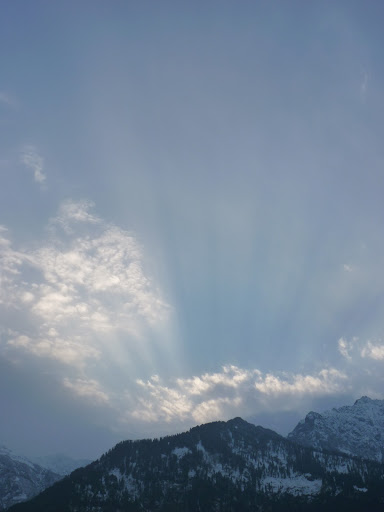


In the afternoon I nearly managed to miss my bus again this time getting lost when trying to find my way back from the 'must see' waterfall that I had been advised to see by a local. I should probably have known better not to have spent so much time admiring the stunning light show as the sun went down. Further over the previous couple of breakfasts I had been devouring a cartoon book by one of the writers of Sesame Street. He documented every day of his year long travel in 1990 with a drawing and some explanation. One such sketch was of the woods around Manali and how easy it is to get lost. I should have paid more attention. As seems to be the way so far I got a lucky break and found my way out after an hour or so of searching through what had taken me five minutes to walk through on the way up. I quickly ran back picked up my backpack and got to the bus just in time. Perfect preparation for another night bus, this time to Shimla.

Friday, 22 October 2010

Mcleod Ganj

I knew that I would like Mcleod Ganj from the moment I stepped off of the bus. I remember thinking to myself oh here we go as I noticed two rickshaw drivers parked directly outside the bus, but not one batted an eye lid. In fact it took quite a lot of convincing to get one of them to take us up to Bhagsu where we would be staying. He seemed much more interested in going to bed.

But it was not just the rickshaw drivers who were relaxed, the whole area was. Admittedly it is not a very Indian place considering that it is home to the Tibetan government in exile but it was all very refreshing.

The chilled atmosphere seemed to rub off on me. For the first few days I largely spent playing cards, reading books and drinking a lot of milk tea and coffee. The downside to staying in a superb guest house with a great communal outdoors area is that it is sometimes hard to find an incentive to do anything active! But in many ways it provided a much needed time to relax and enjoy a slower pace to life.

The principle reason to visit Mcleod Ganj is because it is home to the Dali Lama. Although he himself was off giving talks in America I visited his residency a couple of times. The first time there was, what I understood to be, a major speaker talking to a gathering of monks and a large assembled audience. He seemed to have the audience in the palm of his hand as laughter filled the complex. Other than gathering that they were mostly jokes about yoga my Tibetan let me down.

On the second visit the complex was much quieter allowing me to roam freely throughout the temple and monks 'barracks'. On leaving a number of the monks had gathered for their daily 'discussions'. In pairs one would sit and listen, whilst the other, who was far more animated, argued their points. Normally debating can be noisy but this was a little over the top as every time they wanted to seal a point they either stamped their feet or slapped their hands. The crescendo of noise echoed around the surrounding buildings. On my way out I noticed a couple of westerners giving it a go. For some reason it just didn't look quite the same.

One of the many highlights to Mcleod Ganj was far off the lonely planets radar. Directly outside our guest house stood a tiny temple. It had first aroused interest from the continuous bell ringing and singing that would make its way through into the room at 7am. The exterior of it reminded us of something from Alice in Wonderland. Little did we know that the inside would be just as eccentric. With psychedelic Buddhist statues on the interior walls and model snakes crawling from the ceiling it was quite a sight. The real treat though was going through a snakes mouth and into a cave the winded it's way up, past more statues and masks, until you reached the top of the temple, which looked out over the valley. Both Mark and I were taken aback by the whole design of the place. It was a religious playground, not least illustrated by the smiles of the children running back and forth through the cave. I am seriously starting to doubt that I will ever visit a better temple!

On a couple of days the lure of the snowy peaks that showed themselves on clear days was a little to much. It seems to be a developing habit of mine that when I see mountains I want to climb them! The first attempt largely failed however I did end up at a picturesque waterfall with glacier pools a plenty. Several hours with a book, in the sun, was time well spent! The second attempt was better, in that I got higher, but the clouds came in and ruined any good views, which was disappointing.

Something that I really wanted from Mcleod Ganj was an opportunity to listen to Tibetan Monks share their experiences. Fortunately I got the chance on my final day when I took part in a conversation class. This is something that is run by voluntary groups and you essentially turn up, are given a group to work with and discuss a pre-arranged topic. The main aim of the sessions is to help the locals with their English. The theme for the day was:

What would you change in the world?
What is bad in the world?

I joined in with a group of teenagers and supported them along with a New Yorker. The kids language was basic but it was a joy working with them. At times I almost felt like a teacher again! At the end of the session all the groups had to speak three sentences in answer to the questions. There were the obvious answers from the older groups. STOP WARS, Poverty more charity etc and then my group stood up. The first sentence they spoke was poignant:

1) There should be no evenings only daytime.

This brought a round of applause from the classroom. Ah the group are selecting the good ones from our discussions or so I thought. The second proved to be quite controversial:

2) Everyone should be allowed to wear different types of clothes

A protest against robes! The elder monks seemed not so impressed by this change to the world. Why couldn't they just stick to the obvious answers I thought rather than our meaningless chatter. Oh well there is always time for the third:

3) You should not thrown stones at ducks

Too true! The mind of young Tibetan monks, truly they are in touch with the key issues in the world today.

The session was good fun but I would be lying if I said that I wasn't a little disappointed at not getting to speak in more detail than simple hello's to some of older monks. Luckily though that time came when walking out of the guest house and towards the bus station. I was greeted by a monk keen on a bit of company. It was fascinating listening to him as he talked about making the journey over the Himalayas on foot to reach Mcleod Ganj. They walked every day and most nights, some for up to three months, in nothing more than their robes. It put my efforts to shame. The exchange was truly a superb experience.

After half an hour or so we parted company and I clambered onto the Government bus which would take me overnight to Manali. It seemed like a good idea at the time but looking back on it now I am not so sure.

Sunday, 17 October 2010

Delhi - Amritsar

Delhi wasn't just about the Commonwealth Games. After getting over and around the well publicised hassle that Delhi seems to have in abundance, I found it to have some great places to visit. The humayun tomb, with its Taj Mahal esq design, the Red Fort, which was spectacular from the outside and the Jama Masjid, India's largest Mosque, and boy was it huge, were all impressive. After five days I was quite chuffed with myself considering the general consensus from people was that 1-2 days is the average stay due to the heat and the fact that everyone seems to be out to rip you off. However although I liked it more than I expected I would be lying if I said that I wasn't delighted to be booked on a train ready to leave for Amritsar.

On the eve of departure Delhi did have one last parting gift for me...a rickshaw driver declared that he needed double the fare because the road was closed to the train station and he would need to take a long diversion. Oh how I had wanted to hear a line like that. Laughing I left him and went to the next rickshaw driver, who promptly apologised and drove off. The third let me hop in and away we drove until we met lots of road closed signs due to the cycling event. Fortunately and after considerable negotiations I finally got him to abide by the meter hence meaning no double fares! The story did remind me that actually some crazy stories from rickshaw drivers and touts in Delhi can actually turn out to be true!

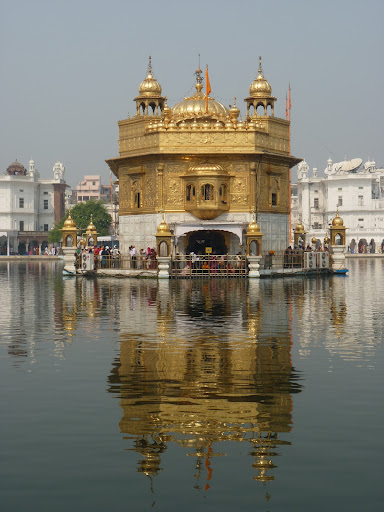
The train journey to Amritsar was painless and I arrived in Sikhism most holy site the following morning. The greatest part that I understood of Sikhism is its inclusiveness. No more is this shown then by how they have built a tourist dorm next to all the pilgrims dorms and within the Golden Temple complex itself. Not only did this provide a great place to meet people and hang out, it also meant that every morning, when exciting the dorm, the Golden Temple stood infront of you, only 20 or so meters away. Oh and it was also free to stay there (donations were encouraged)!

To get to the waters edge though you had to dress modestly, clean your feet and cover your hair. I just about managed the first two rules however the later one was a struggle, not least in negotiating the outer rim of the temple trying to find the man with the free head scarfs. Eventually after much panicking from some of the pilgrims I found the man. My punishment for such a crime, getting to wear a nice bright pink bandana. Sikhs seem renowned for their bright turbans and head wear but this was taking the mick.


The temple itself is absolutely spectacular, especially at night. Sat at nine in the evening by the waters edge, listening to the monks chanting was a beautiful experience. But whilst its grandness is its selling point, the pilgrims themselves were what made the place so special. I lost count of the amount of times that I was stopped and talked to. At one point two guys who worked in the temple and were on their free time, took me to a special vantage point to see the holy book get taken out of the temple to be 'put to sleep'. It was fascinating listening to them explaining the importance of the ceremony and also the basics behind being a Sikh.


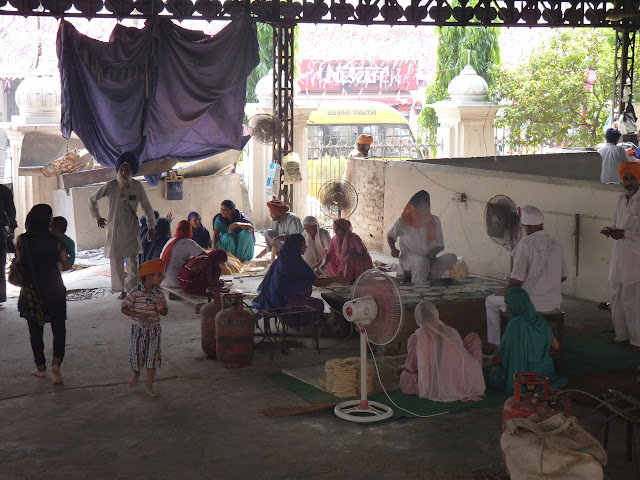
Another feature of the Golden Temple is the communal dining room. Here volunteers feed between 60 and 80,000 people a day. Class, religion and nationality is totally irrelevant. The food whilst basic was good, especially the sweet rice and rice pudding. On one day, I and a group of other people from the dorm volunteered by rolling Chapattis which were then cooked and sent upstairs for eating. After an hour I went up to eat and noticed the man next to me looking strangely at his plate. On closer inspection there sat a very odd sized, thinly rolled Chapatti. Amused by it being one of ours I apologised to him. He saw the funny side and seemed very impressed that we had spent time volunteering.


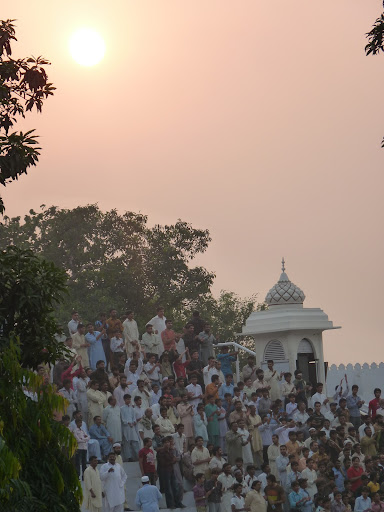
Outside of the temple, Amritsar also has another big trick up its sleeve. On the first evening, I joined an Israeli guy to the Indian, Pakistan border to witness the closing of the border ceremony. It was a truly hilarious and incredible site. There must have been around 3-4,000 Indians crammed into the stands surrounding the gate. On the other side the Pakistan crowd was out in good numbers too. What followed was a Monty Python sketch as both sides tried to out do each other in a highly choreographed event. For example, the crowd, aided by cheerleaders and flag bearers attempted to out sing each other, the soldiers, on microphones, attempted to out shout each other and for a good half an hour soldiers took it in turns to out goose step, and adjust their hats better than the other side. It was utterly bizarre but made for fascinating viewing.


In many ways I could have stayed in Amritsar for many more days but instead choose to join two guys who were heading further north. So after an eventful couple of days I decided to play Russian roulette with the local bus system and take a ten odd hour journey up to Mcleod Ganj, the official residence of the Dali Lama.

Saturday, 9 October 2010

Delhi 2010


The Commonwealth Games, in India, was a disaster waiting to happen. That was the general view of people I spoke to when in Nepal and they had justification in saying it. With bridges collapsing, ceilings falling in and an apparent lack of enthusiasm from the host population, it wasn't looking great. However after going to three different venues over three days, I think that as of the time of writing it has been a success. Considering all of the problems that led up to it it was a thoroughly 'organised' and enjoyable event.

I went to see Athletics on the first day. Watching the 100 meters live has always been an ambition of mine and whilst it may not have had the under 10 seconds sprinters it was still incredibly impressive to see how quick they actually go. Yesterday it was the turn of boxing. Saw the middleweights and super-heavyweights fight it out. By far the most entertaining bouts were with the Indian fighters as the crowd in the stadium went absolutely crazy. This morning I finished off my games binge by watching our Mens and Womens hockey teams win and also the Australians narrowly edge out the Pakistani's.

For all the enjoyment I and others I spoke to had, we all shared big issues with the intelligence of the organisation of getting into the stadiums. The organisation committee has essentially handed over the running of the games to the Indian police. From my limited experience of them they are about as unhelpful and unintelligent as you can get. As a result the games itself is well organised, just lacking in common sense. Hence it was no surprise to see a 42 odd list of restricted items. This included cameras, any sort of bag, Ipod headphones (the Ipod is fine to take in) and any coins in your wallet! I even got interrogated for several minutes over some paper in my pocket I had brought for a blocked nose! A lot of people have had to make difficult decisions whether to leave things in a left property box or not enter the stadium. This procedure of searching and confiscating everything followed me to every stadium although I did get some revenge on the second day by striking (accidentally) one of the policemen in the face, much to his partners (and mine) amusement. He wasn't so happy and demanded to see the coins in my pocket, that I didn't have.

I also found the rigid structure to getting into the stadiums utterly unbelievable. At one point, after walking aimlessly around a perimeter wall attempting to find gate 6 and access to the stadium, I was stopped 10 meters away from it. There was nothing but a clear path. However the armed police decided I couldn't get to it that way and instead had to cross two bridges (there was no water!). I then decided to attempt to cross another way, again clear road but then as quick as a flash more armed police! It took a further 45 minutes and for no reason at all. I suppose in hindsight the farcicle nature to some of the decisions were actually quite amusing however at the time and when in a rush to get to your seat they are nothing short of bewildering.

But saying all that when inside the stadiums everyone, including myself was having a great time. The Indian crowd, when it's their own boys and girls, or it's the Pakistan team or even England and Wales sure do get behind them, which added to the occasion.

Thursday, 7 October 2010

Kathmandu

What first was mad soon became pretty off putting. My first experience of an Asian city did not leave me with much hope. The monsoon had created a depressing feel to the place. Worst of all however was arriving at the end of a two week garbage strike. It quite literally was everywhere. The smell was horrendous and at times you had no choice but to walk straight through it. The thought of heading to the mountains had never felt so good.

"Is this the same city?" I exclaimed on my return. The pavements were now relatively clear, dust had replaced water and there was no longer a need to hold your nose in fear of vomiting. Instead there stood a vibrant and hectic city which proved to be very hard to leave.

In terms of traditional sightseeing I feel that it lacks maybe the highlights of similar sized cities. This may however have been due to the superb guest house I stayed at, where once sat in the garden it was nearly impossible to leave due to the amount of people to talk to. I did however manage to get out and about a fair bit, whether it was fighting off the monkeys at Swayambhunath, getting blessed by Buddhist monks at Boudha, enjoying the well hidden ex-pats farmers market, or watching an hour long cremation service at Pashupatinath. My favourite place however was sat on numerous times inthe sunshine chatting and watching the world go by in Dubar Square. Bliss.

In the end it was hard leaving Kathmandu but with the guys and girls I had met over the week departing for various treks and my India visa running down, it seemed the right time to strike off on my own and head to Delhi.

Thursday, 30 September 2010

Part Two: Namche to Gokyo followed by a huge diversion to Everest base camp

Fortunately for us the organised groups made their way up towards Everest Base camp. We however diverted off towards the village of Gokyo. Set at 4800 meters it is home to six sacred lakes as well as what everyone we spoke to before hand described as the best panoramic view of the Himalayas available.

The increased altitude slowed what had otherwise been an impressive pace. In total from Namche to Gokyo it is a seven hour climb. In reality it took us four days due to the need to acclimatise properly. On arrival to Gokyo the air felt noticeably thinner and the head veered towards a headache. However as we settled into the lodge we met up with a variety of fellow independent travelers who persuaded us to make an attempt on Gokyo Ri the following morning. So at 4:30am, with the head torch on, we navigated across a large bog by the side of the third lake and up 600m to 5400m. For Ian the altitude took its hold and he had to turn back. Luckily I seemed to feel stronger the higher I climbed and make the top in under two hours. The reward for the early morning excursion? Blanket cloud and freezing temperatures. The mood was only slightly lifted by an impromptu performance by the two Japanese 'underground' musicians who decided only their own songs could help the clouds to clear. It was a bizarre moment.

We spent the rest of the day getting over our disappointment by holding skimming stone contests on the sacred lakes. The fifth lake stands at 5000 meters. A good two hours away from Gokyo it was probably the most isolated that you could ever feel. Stood still there was not a sound that could be heard.

The following day followed a similar pattern with both high and low points. The good news was that we met and indeed led a new party of independent trekkers up Gokyo Ri. We awoke to the sounds of dripping water outside the window. Frustrated and annoyed by the rain we poked our heads outside to call the trip off to find that it was not rain but melting snow. With a light dusting on the ground and stars in the sky we walked as quickly as possible through increasing depths of snow, creating new paths up the mountain. This time the views were breathtaking. I was third up to the top. Standing on a boulder, I span 360 degrees. I was entirely surrounded by snow topped peaks. For the next hour I relaxed taking in the utterly spectacular views in front of me. A good half an hour of this was taken with debating which one was Everest. At first it was the small one in the distance, then it was the one to the right of Nuptse. It turned out it was the tallest one, right in front of us. So close in fact that you felt like you could reach out and touch it.

Triumphant, we reluctantly made our way down as the clouds moved in. After a good breakfast our trekking party of two became three as Brian, an American, entrepreneur, impending novelist and blogger joined us. The Cho La Pass is well known for being challenging so we were delighted to be in each others company. For the rest of the day all we had to do was follow a path over a glacier for two hours.

The problem? Our map and the latest edition of the lonely planet was out of date. The well trodden path that we followed soon led to a 20ft drop off into a huge lake. Not to be discouraged we spent three to four hours attempting to plot our own path over the glacier. Three quarters of the way across we realised our attempts were hopeless. We were greeted by a huge lake that showed no possibility of getting across. With sand cracking beneath our feet and the sounds of the glacier moving all of the time we agreed it was time to make a quick retreat.

There was an alternative. A small bridge further back down the route would allow us to navigate around the glacier. The next problem. The monsoon. The heavy rain that had fallen prior to our arrival had washed the bridge away. We were stuck with either a retreat to Gokyo and to hope to hire a guide for the following day. Or alternatively to attempt a mammoth day looping back round and as far up the Everest path that we could.

With acclimatisation no longer an issue we raced around and made fantastic progress. In two days we made it to Gorak Shep and collapsed in a heap. At 5100 odd meters it is said that very few people sleep well there. I had no such problem. From there we did another early morning ascent up to Kala Pathar (Everest's Gokyo Ri) where we saw more incredible views from the top. Most pleasing was completing the ascent in under an hour, overtaking the couple of groups that were half way up it when we started, including one Australian group much to their frustrations.

We then did the unusual act of going to Everest Base Camp in the same day. A lot of people run EBC down saying it's not interesting, you don't get a view of Everest etc. However I found it fascinating. Again we had to navigate over a glacier, but this time it was successful. There were three expedition parties waiting to go. It was great watching the Czech group prepare and just sit, drinking a cup of tea thanks to a kind Aussie we met and viewing the Khumbu ice fall in all its glory.

From then on we sprinted back down as quickly as we could back to Jiri. Again it was a painful experience but highly rewarding. Encouraged by the discussions of chocolate and beer we came down in great time and rode the gauntlet of the bus system back to Kathmandu. There we ate cheese burgers, snickers bars, various biscuits with peanut butter in them and lastly a few Everest beers.

It was an amazing experience and one that I would recommend to everyone.

Jiri to Namche

I apologise in advance, twenty four days of trekking provided an incredible adventure and with it a long probably unreadable series of blog posts. If I don't write it hear then the memories will probably go the same way as my diary. Lost somewhere over 5000 meters.

So here we go...

We arrived in the small rural community of Jiri on the 4th of September. We being myself and Ian, a Londoner who had been in Nepal for a few months and before it India for six. Why Jiri? Perhaps it was snobbishness in avoiding the short cut now taken by the vast majority of trekkers i.e. flying into Lukla, possibly it was cheapness in not wanting to pay a fortune for flights, but in reality it was probably a strong case of insanity. The first major obstacle in the trip was getting to experience the local Nepali public bus system. From Kathmandu it is a ten hour journey through the mountains and at times back into the 1970's. Hindu Pop blared out of the windows and there was a care-free attitude as to when and who we stopped for. At times the bus dabbled with disaster cramming as many as 100 people of all ages both within and on top of the bus. For a good hour we had the dubious pleasure of holding and entertaining a small child whose mother vanished from view somewhere within the crowds. Further to the people there were huge bags of rice, corn, sugar and even a retro large television that occupied two of the seats.


Fortunately with both ourselves and gear in tact we arrived in Jiri to start the following day. Outside of the bus (described to us as the most dangerous part of the trek), there is one other downside to starting in Jiri. The sheer amount of pain we endured over the course of the six days. Every day we went over 1000 meters in terms of ascents and descents. On one day we descended 2000 meters and ascended 1800 meters. It hurt a lot. The reward...being able to see Nepal at its best. There was a wonderful charm of walking into a tiny village after 10 hours on the path, to be greeted by Nepali families and allowed to share some time with them living under their roof. There were many happy memories from this stage of the trek, whether it be staying under the same roof and indeed being served by guys who had climbed Everest and many of the other highest mountains in the world, or sharing photos from the trek with the children from different families. During one such moment, the youngest of one of the families, five years old and with apparently no English, perked up and disagreed with my definition of a horse, frantically naming it as a donkey. We agreed to differ.

The route from Jiri was the original route taken by Everest explorers of old. At times, with no other Westerners seen for days on the trail it was hard not to feel like a bit of a pioneer. At one stage a playground emptied out onto the path, each child desperately wishing to beg us 'namaste' and hear us say it back to them. It was a really special moment.

After five days we hit the main trail from Lukla. It felt like and indeed was a new stage of the adventure. The basic villages with people living off of the land changed to nearly every house being a trekking lodge or restaurant. No more did we have to ask random houses for a room. With the increased commercialism came more fellow trekkers, many in large groups. Fortunately the Jiri stretch had really improved our fitness levels and we powered passed them and up the steep climb into Namche where we spent two days acclimatising. From there we planned to make our way up to Gokyo, across the Cho La Pass and over to base camp. However, as with all well made plans things don't always work out the way you want it to.